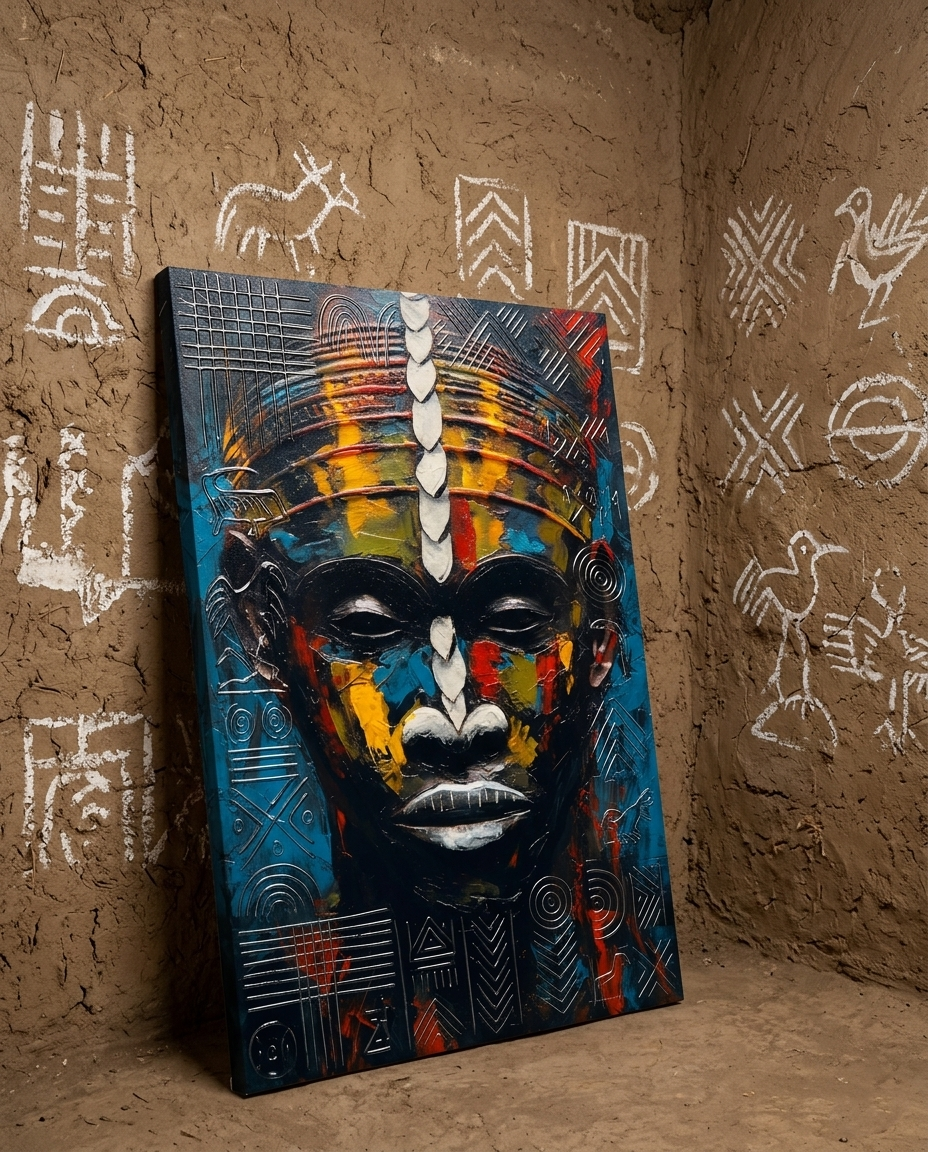
Plate I
Eze Mmiri
King of the Waters
He rules the place where rivers remember. The zigzag of Ikaki, the flow of water, runs through him to the silt.
An archive of presencessummoned from the deep
Ancestral masks, called back through the machine and finished by the hand. The masks have always known your name.
Ojoojookalaba is a body of work in which generative models are set a daring task: to summon the ancestral masks and effigies of the African continent, and to return them changed.
Each composition is born in the machine, pressed onto canvas, then finished by the hand in transparent acrylic. Into the surface are inscribed the marks of Uli and Nsibidi, the graphic languages of the Igbo. The result lives in a single plane that is neither past nor future.
This is not decoration for its own sake. It is a living archive, a ward, a presence pressed into pigment.
In Igbo, ícho mma means to search for beauty, to decorate. Beauty was held close to morality. Uli was drawn by women on skin and on the clay walls of the compound, its motifs named for the world they resembled. Nsibidi guarded what was not to be said aloud.
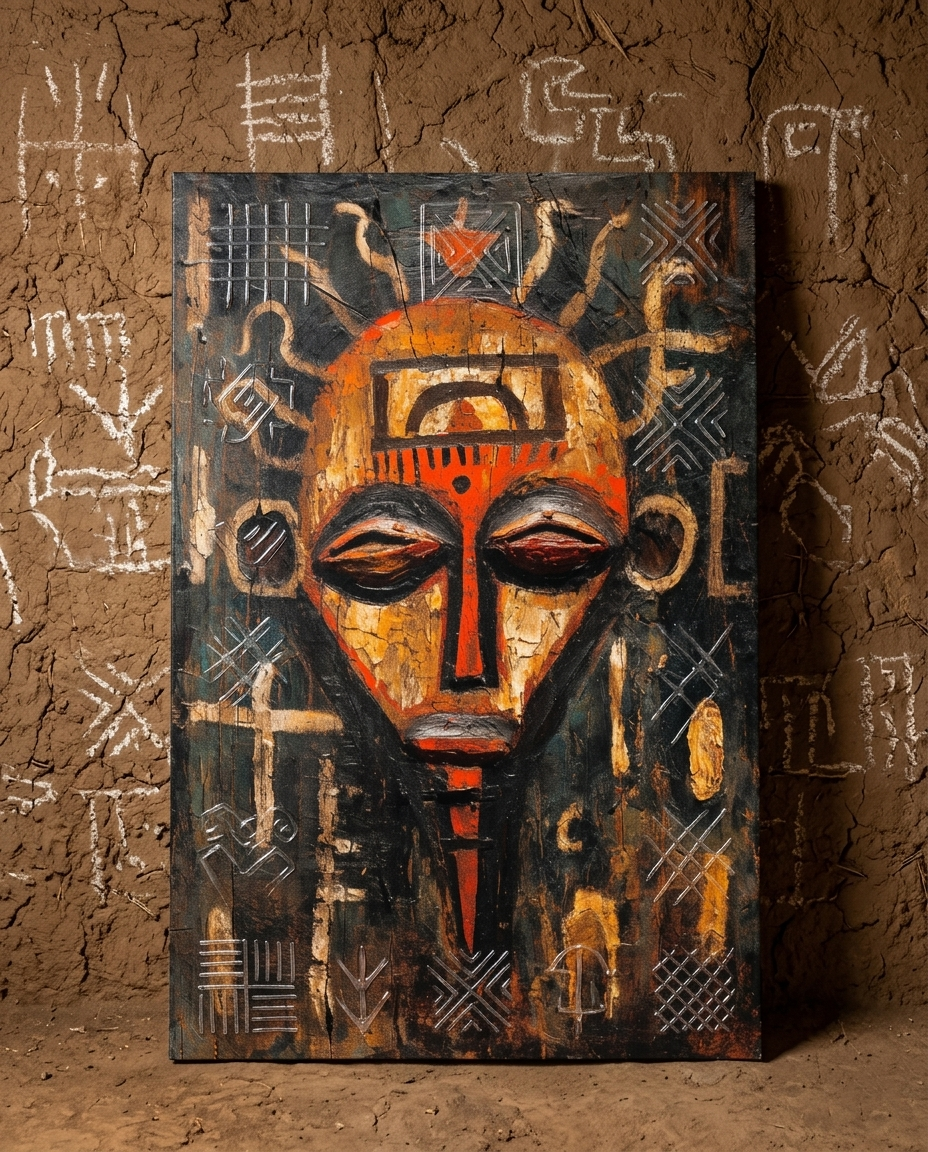
Plate I
King of the Waters
He rules the place where rivers remember. The zigzag of Ikaki, the flow of water, runs through him to the silt.
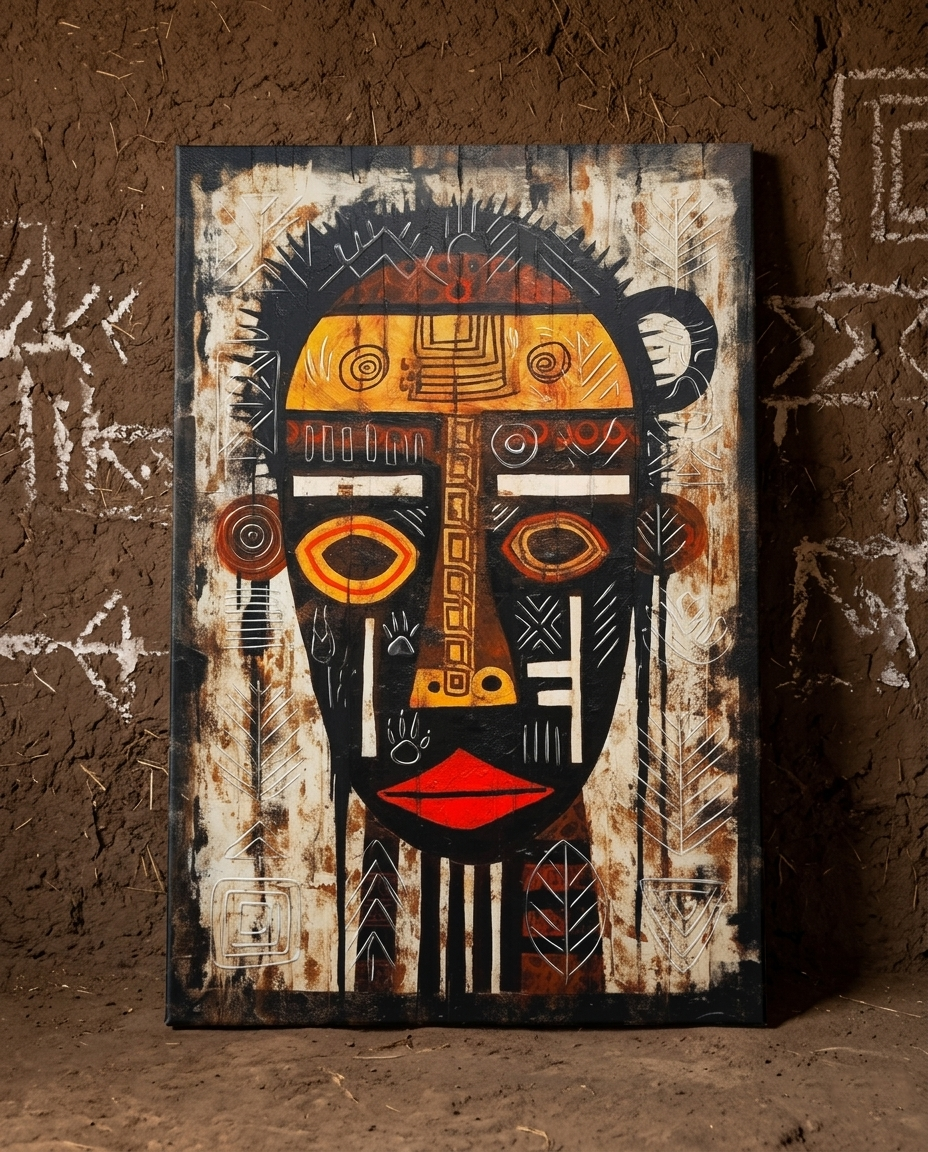
Plate II
The Watcher
Eyes closed, yet nothing passes him. He keeps the threshold between what sleeps and what stirs.
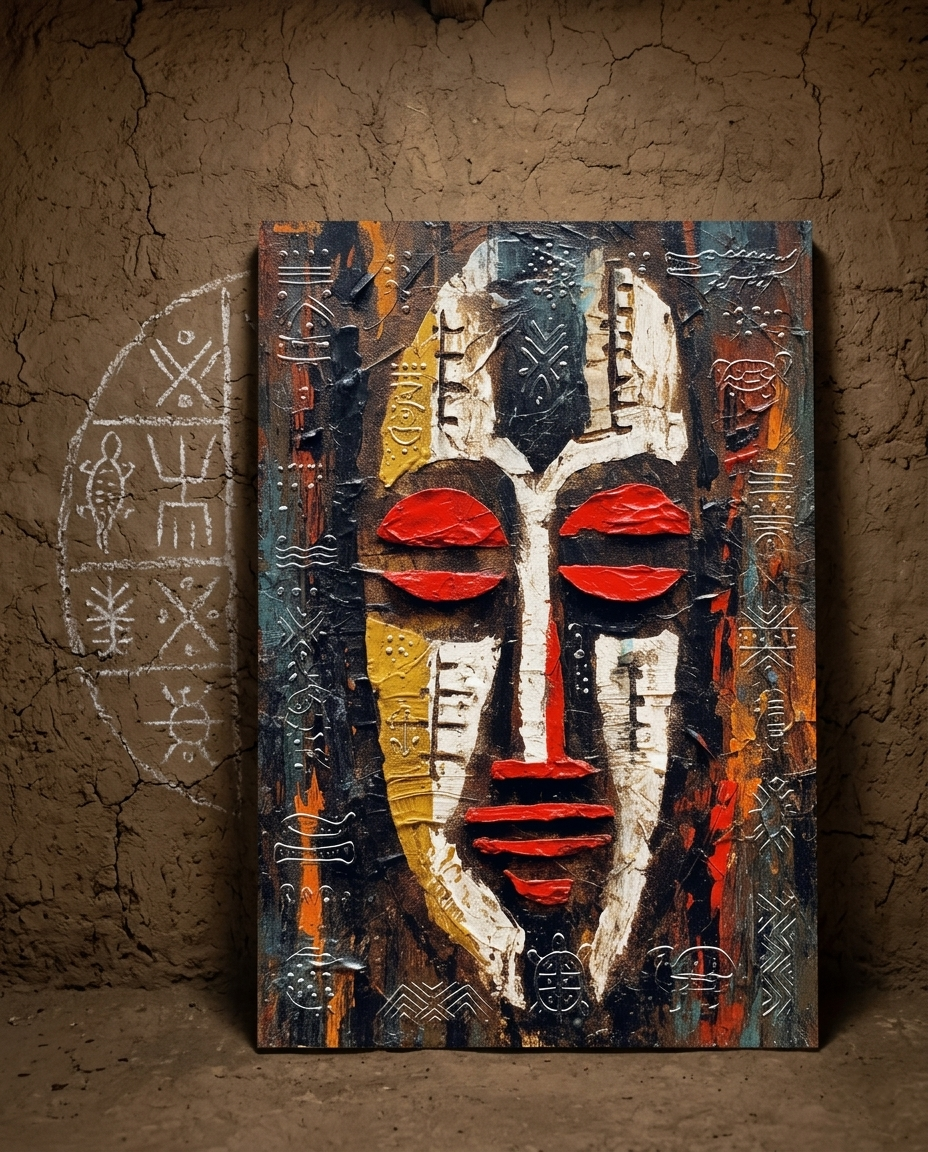
Plate III · Centrefold
Child of the Sun
Born of the first morning. His face is a map of light that no shadow has finished reading.
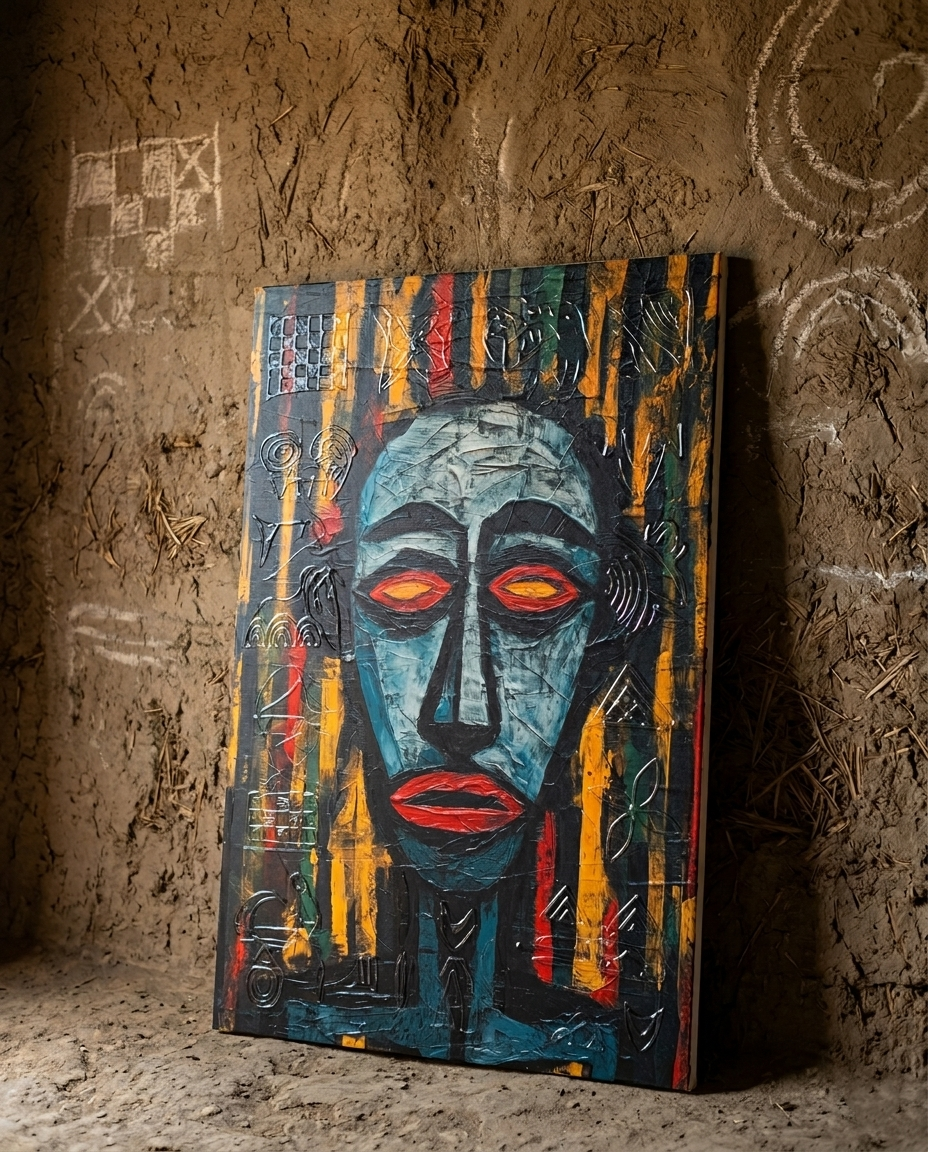
Plate IV
Slayer of Time
He devours the hours and returns nothing. Before him, yesterday and tomorrow lose their names.
Plate V
Eyes of Fire
What he looks upon, he keeps. Twin embers where eyes should be, burning the seen into memory.
Models are tasked to resurrect the iconography of ancestral masks and effigies, drawn up out of the deep water of the dataset.
The spectral vision is pressed to canvas. It is given weight, surface, and the texture of a thing that exists.
In transparent acrylic, by hand, the work is layered with physical brushwork and African symbol.
The marks are set into the piece, signing it to a lineage far older than the algorithm that began it.
When you stand before a piece and feel something shift, something ancient stir that you cannot name, that is not aesthetics. That is recognition. Those who carry these works home are not patrons. They are custodians of the frequency.
Ebere was not trained to make Ojoojookalaba. He was trained to see what others could not. Years of visual craft, deep roots in Igbo cultural identity, and an uncompromising reverence for the supernatural traditions of the continent forged the conditions for this form to emerge. It did not happen by design. It was called into existence.
Today Ojoojookalaba stands as a singular contribution to contemporary African art, made under Syscroft Studio in Lagos.
For those who carry the work